Why Startups Fail

Reason 1: Market Problems

A major reason why companies fail, is that they run into the problem of their being little or no market for the product that they have built. Here are some common symptoms:

  • There is not a compelling enough value proposition, or compelling event, to cause the buyer to actually commit to purchasing. Good sales reps will tell you that to get an order in today’s tough conditions, you have to find buyers that have their “hair on fire”, or are “in extreme pain”.   You also hear people talking about whether a product is a Vitamin (nice to have), or an Aspirin (must have).
  • The market timing is wrong. You could be ahead of your market by a few years, and they are not ready for your particular solution at this stage. For example when EqualLogic first launched their product, iSCSI was still very early, and it needed the arrival of VMWare which required a storage area network to do VMotion to really kick their market into gear. Fortunately they had the funding to last through the early years.
  • The market size of people that have pain, and have funds is simply not large enough

Reason 2: Business Model Failure

As outlined in the introduction to Business Models section, after spending time with hundreds of startups, I realized that one of the most common causes of failure in the startup world is that entrepreneurs are too optimistic about how easy it will be to acquire customers. They assume that because they will build an interesting web site, product, or service, that customers will beat a path to their door. That may happen with the first few customers, but after that, it rapidly becomes an expensive task to attract and win customers, and in many cases the cost of acquiring the customer (CAC) is actually higher than the lifetime value of that customer (LTV).

The observation that you have to be able to acquire your customers for less money than they will generate in value of the lifetime of your relationship with them is stunningly obvious. Yet despite that, I see the vast majority of entrepreneurs failing to pay adequate attention to figuring out a realistic cost of customer acquisition. A very large number of the business plans that I see as a venture capitalist have no thought given to this critical number, and as I work through the topic with the entrepreneur, they often begin to realize that their business model may not work because CAC will be greater than LTV.

The Essence of a Business Model

As outlined in the Business Models introduction, a simple way to focus on what matters in your business model is look at these two questions:

  • Can you find a scalable way to acquire customers
  • Can you then monetize those customers at a significantly higher level than your cost of acquisition

Thinking about things in such simple terms can be very helpful. I have also developed two “rules” around the business model, which are less hard and fast “rules, but more guidelines. These are outlined below:

The CAC / LTV “Rule”

The rule is extremely simple:

  • CAC must be less than LTV

CAC = Cost of Acquiring a Customer
LTV = Lifetime Value of a Customer

To compute CAC, you should take the entire cost of your sales and marketing functions, (including salaries, marketing programs, lead generation, travel, etc.) and divide it by the number of customers that you closed during that period of time. So for example, if your total sales and marketing spend in Q1 was $1m, and you closed 1000 customers, then your average cost to acquire a customer (CAC) is $1,000.

To compute LTV, you will want to look at the gross margin associated with the customer (net of all installation, support, and operational expenses) over their lifetime. For businesses with one time fees, this is pretty simple. For businesses that have recurring subscription revenue, this is computed by taking the monthly recurring revenue, and dividing that by the monthly churn rate.

Because most businesses have a series of other functions such as G&A, and Product Development that are additional expenses beyond sales and marketing, and delivering the product, for a profitable business, you will want CAC to be less than LTV by some significant multiple. For SaaS businesses, it seems that to break even, that multiple is around three, and that to be really profitable and generate the cash needed to grow, the number may need to be closer to five. But here I am interested in getting feedback from the community on their experiences to test these numbers.

The Capital Efficiency “Rule”

If you would like to have a capital efficient business, I believe it is also important to recover the cost of acquiring your customers in under 12 months. Wireless carriers and banks break this rule, but they have the luxury of access to cheap capital. So stated simply, the “rule” is:

  • Recover CAC in less than 12 months

Reason 3: Poor Management Team

An incredibly common problem that causes startups to fail is a weak management team. A good management team will be smart enough to avoid Reasons 2, 4, and 5.  Weak management teams make mistakes in multiple areas:

  • They are often weak on strategy, building a product that no-one wants to buy as they failed to do enough work to validate the ideas before and during development. This can carry through to poorly thought through go-to-market strategies.
  • They are usually poor at execution, which leads to issues with the product not getting built correctly or on time, and the go-to market execution will be poorly implemented.
  • They will build weak teams below them. There is the well proven saying: A players hire A players, and B players only get to hire C players (because B players don’t want to work for other B players). So the rest of the company will end up as weak, and poor execution will be rampant.
  • etc.

Reason 4: Running out of Cash

A second major reason that startups fail is because they ran out of cash. A key job of the CEO is to understand how much cash is left and whether that will carry the company to a milestone that can lead to a successful financing, or to cash flow positive.

Milestones for Raising Cash

The valuations of a startup don’t change in a linear fashion over time. Simply because it was twelve months since you raised your Series A round, does not mean that you are now worth more money. To reach an increase in valuation, a company must achieve certain key milestones. For a software company, these might look something like the following (these are not hard and fast rules):

  • Progress from Seed round valuation: goal is to remove some major element of risk. That could be hiring a key team member, proving that some technical obstacle can be overcome, or building a prototype and getting some customer reaction.
  • Product in Beta test, and have customer validation. Note that if the product is finished, but there is not yet any customer validation, valuation will not likely increase much. The customer validation part is far more important.
  • Product is shipping, and some early customers have paid for it, and are using it in production, and reporting positive feedback.
  • Product/Market fit issues that are normal with a first release (some features are missing that prove to be required in most sales situations, etc.) have been mostly eliminated. There are early indications of the business starting to ramp.
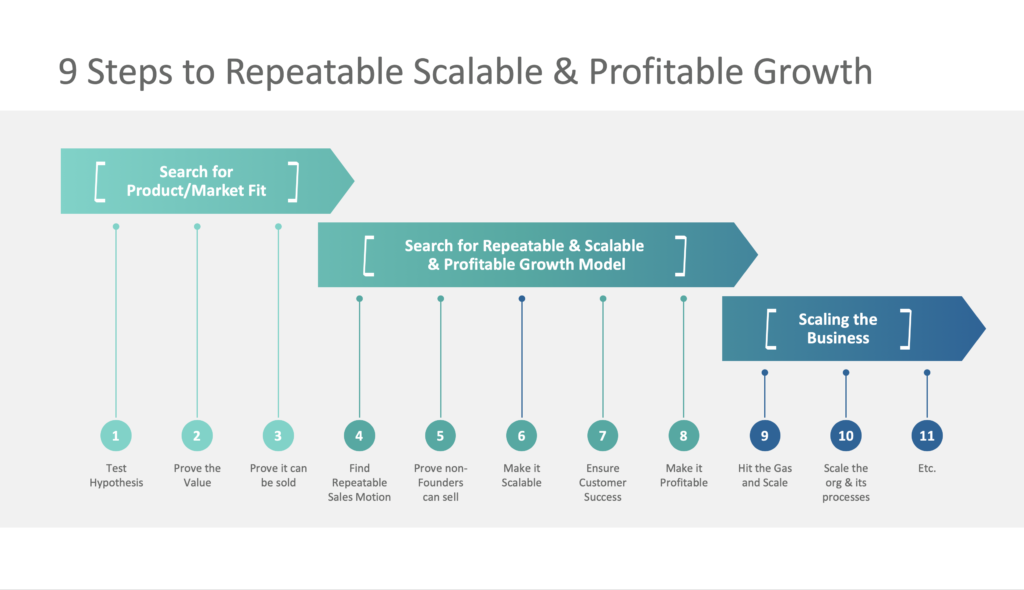
  • Business model is proven. It is now known how to acquire customers, and it has been proven that this process can be scaled. The cost of acquiring customers is acceptably low, and it is clear that the business can be profitable, as monetization from each customer exceeds this cost.
  • Business has scaled well, but needs additional funding to further accelerate expansion. This capital might be to expand internationally, or to accelerate expansion in a land grab market situation, or could be to fund working capital needs as the business grows.

What goes wrong

What frequently goes wrong, and leads to a company running out of cash, and unable to raise more, is that management failed to achieve the next milestone before cash ran out. Many times it is still possible to raise cash, but the valuation will be significantly lower.

When to hit Accelerator Pedal

One of a CEO’s most important jobs is knowing how to regulate the accelerator pedal. In the early stages of a business, while the product is being developed, and the business model refined, the pedal needs to be set very lightly to conserve cash. There is no point hiring lots of sales and marketing people if the company is still in the process of  finishing the product to the point where it really meets the market need. This is a really common mistake, and will just result in a fast burn, and lots of frustration.

However, on the flip side of this coin, there comes a time when it finally becomes apparent that the business model has been proven, and that is the time when the accelerator pedal should be pressed down hard. As hard as the capital resources available to the company permit. By “business model has been proven”, I mean that the data is available that conclusively shows the cost to acquire a customer, (and that this cost can be maintained as you scale), and that you are able to monetize those customers at a rate which is significantly higher than CAC (as a rough starting point, three times higher). And that CAC can be recovered in under 12 months.
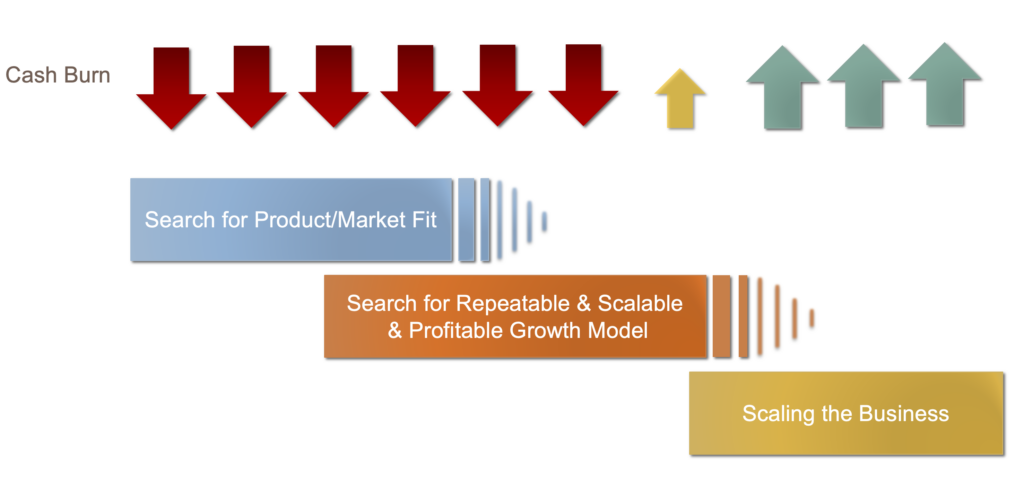
For first time CEOs, knowing how to react when they reach this point can be tough. Up until now they have maniacally guarded every penny of the company’s cash, and held back spending. Suddenly they need to throw a switch, and start investing aggressively ahead of revenue. This may involve hiring multiple sales people per month, or spending considerable sums on SEM. That switch can be very counterintuitive.

Reason 5: Product Problems

Another reason that companies fail is becuase they fail to develop a product that meets the market need. This can either be due to simple execution. Or it can be a far more strategic problem, which is a failure to achieve Product/Market fit.

Most of the time the first product that a startup brings to market won’t meet the market need. In the best cases, it will take a few revisions to get the product/market fit right. In the worst cases, the product will be way off base, and a complete re-think is required. If this happens it is a clear indication of a team that didn’t do the work to get out and validate their ideas with customers before, and during, development.

Be Sociable, Share!
  • Pingback: 6 things VCs look for in an investment – For Entrepreneurs

  • Pingback: Haut Tech » SaaS: Get a Realistic Roadmap

  • http://www.tristart.co.uk Ken Ashley

    Another reason startups fail is that the entrepreneur doesn't recognize his or her weaknessess and how to apply best practice policies to improve those weaknesses. There are 19 key categories that research has shown which govern the operational success of a company. If you know how you score in each you can develop a strategy to focus on the areas which would have the quickest and biggest positive impact. Building a successful company is a process.

  • http://www.tristart.co.uk Ken Ashley

    Another reason startups fail is that the entrepreneur doesn't recognize his or her weaknessess and how to apply best practice policies to improve those weaknesses. There are 19 key categories that research has shown which govern the operational success of a company. If you know how you score in each you can develop a strategy to focus on the areas which would have the quickest and biggest positive impact. Building a successful company is a process.

  • http://twitter.com/neilellis Neil Ellis

    Hi David

    So in slightly more than 140 characters :)

    My questions are about the scenario of a company who is attempting to get maximum market penetration and are likely to try and avoid recuperating their cost of acquiring customers – as almost every means of doing so may either deter the customer from using the product or will push them into the hands of a competitor. These companies of course have an end goal to saturate the market, then when there is no room left for competition and the customer is already hooked they can safely introduce ways to make profit without fear of deterring customers. This is the pattern I’ve seen for many high tech consumer market startups such as Google, Facebook and now Twitter. So for a company who are truly subject to the network effect like these companies they must be either huge or nothing to survive. In their case the goal surely is not to recuperate their cost of acquisition in say 12 months but instead over a 5-10 year period once they have dominated their market.

    In general my comments on Twitter relate to the fact that no matter how good the advice from VCs they inevitably contradict one another and also contradict success stories. I’ve started to come to the belief that actually the complexity of predicting the success of the startup is so incredibly high that actually no matter what rationale people place on why they back a particular company, it is their ‘gut instinct’ that actually makes the choice. Then once decisions are made, both the fundamental attribution error and survivor bias kicks in causing us to look at the patterns between successful companies and not the conditions that helped them be successful or the companies who were just like them but failed :)

    That said it does no harm for me to look for the patterns in advice from VCs/Angels to help identify weaknesses that can be strengthened.

    Would love to hear your thoughts David.

  • http://www.forentrepreneurs.com David Skok

    Neil,

    Thanks for taking the trouble to explain this more clearly. The piece of my advice that I believe you are referring to is the “business model failure” where entrepreneurs are too optimistic about the cost acquire their customers.

    When I look at Google, Facebook and Twitter, I see three companies that managed to achieve true viral customer acquisition, which means that their costs to acquire customers were amongst the lowest you will find. Granted they did have some costs, but compared to other companies, they were extremely low. In my book, these companies represent the ultimate best investment around: very low CAC (cost of customer acquisition), sticky, good barriers to entry, and with enough customer engagement that even though it may not have been clear immediately what was the best monetization, there was very strong evidence to suggest that there would be some good options.

    The business models that fail are the entrepreneurs that believe they will be lucky enough to get true viral growth (like Google, Facebook, and Twitter), and are not able to pull that off. Unfortunately there are really only a very small handful of companies that do get true viral customer acquisition, and the rest are forced to work very hard, and find other means to get each customer. Unless the entrepreneur is really sure they will get true viral growth, they should plan for the costs of acquiring each customer, and figure out how they can finance the capital requirements of the business, and also at some future stage create a monetization strategy that will result in each customer being profitable to them.

    That was the essence of what I was trying to say above, and in the other article on a similar topic: http://www.forEntrepreneurs.com/startup-killer. I hope this clarifies, but if not, let’s continue the dialog.

    The other thing that might interest you is a blog post that I did on viral marketing: http://www.forentrepreneurs.com/lessons-learnt-viral-marketing/

    Best, David

  • http://twitter.com/neilellis Neil Ellis

    Kudos David, that is one thorough article on viral marketing, I now have one more article to add to my homework :) I get your point about the potential failure of a viral model and the need to then consider the ongoing cost of acquiring customers and whether it is financial viable to do so.

    Thanks for such a full and coherent reply.
    Neil

  • http://twitter.com/muthuka Muthu Arumugam

    It’s a great article and thanks for this. It was a touch decision to set the pricing since we are all first time entrepreneurs and happened not to raise so far. But we changed the pricing couple of times to find the right one for our existing customer base. How do we balance between not changing too many times or pivot when needed?

  • http://www.forentrepreneurs.com David Skok

    That is a really hard question for me to answer without knowing a lot more about your specific situation. I believe you should trust your own judgment on this, even though it may be hard to make a decision.

  • buybatterycharger

    Samsung TL100 Battery Charger
    Voltage: 100V-240V(Input), 12V-1A(Output)
    Dimension: 106.50 x 69.00 x 37.00 mm
    Weight: 350.00 g
    Inventory: In Stock 
    Selling Price: $15.95 
    http://www.samsung-battery-charger.com/Battery-Charger/Samsung-TL100-Charger.html

  • http://www.freshwebmedia.com.au/ small business web design

    Thanks for taking the trouble to explain this more clearly. The piece of my advice that I believe you are referring to is the “business model failure” where entrepreneurs are too optimistic about the cost acquire their customers. 

  • http://lagosbusinesses.blogspot.com/ Small business Ideas

    This reminds me of an article on my blog on the major causes of business failure. Failure can be avoided even if success is not guaranteed, I guess a good starting point for success in business will be to review causes of failures such as the ones you have outlined here.

    Great post!

  • http://www.wolftools.net/ John taylor

    Really good read and just sent link to my two business partners.  “When to hit the accelerator pedal” is the most
    difficult and most speculative challenge we have in our industry as our product
    that is weather retaliated regards to demand.

    Will revisit more than once!    
     

  • http://www.forentrepreneurs.com David Skok

    John, I wrote more on the topic of when to hit the Startup Accelerator Pedal in this blog post: http://www.forentrepreneurs.com/setting-the-startup-accelerator-pedal/
    It might be of help.
    Best, David

  • http://www.wooden-garden-furniture.com/ Ian

    This is a great post, read once, then again and now I have printed and will read again until it sinks in. Going to share with all of my team, need more articles like this.

    These comments all make sense, the running out of cash is so true, be careful of this pitfall!.

    Thanks, look forward to reading more.

  • http://www.jointingmortar.co.uk/ Jonathon

    Great read, went self employed two years ago and all this applies!!

  • http://www.wooden-garden-furniture.com/ Ian

     Agree fully, will keep coming back too

  • Peter

    Every entrepreneur should read this! Because of my sales background I was one of those business owners over confident, figuring it would be easy to acquire customers. I have learned the hard way, and have had to settle for organic growth (which is frustrating because we have a scalable product). Even with major affiliate contracts/target marketing I have found it is very difficult to attract a mass of new customers.  I have build a proprietary product with a very high value proposition. However, I failed to realize I knew very little about efficient marketing. In my business, I have to be careful of my marketing initiatives, the wrong marketing could deliver nightmare customers and drive my CAC sky high. I’m tying to find a balance. Any suggestions? 

  • http://www.forentrepreneurs.com David Skok

    The best advice I can give you here is to start Inbound Marketing. I have a short post on it here: http://www.forentrepreneurs.com/sales-marketing-machine/inbound-marketing/. The folks at HubSpot invented this term, and their website is full of terrific educational content on the topic. It will result in a steadily growing flow of leads at a very low cost, that usually convert at a higher rate than paid leads.

  • karv smith

    Running out of the Cashflow Problems is some time become start up fail main reason.. 

  • http://www.forentrepreneurs.com David Skok

    Agreed!

  • Sheddy

    I think this article was good in how it pointed out the fine easily overlooked details.

  • Venky

    David,
    For Twitter and Facebook, it would be appropriate to say that they have low user acquisition cost. I would imagine a customer is one who pays for the service. By that definition, the customers of Facebook are the ones who pay for Facebook ads.

  • Sathishkumar Duraisamy

    Hi,

    Is there any research data that supports above answer.

  • http://www.facebook.com/donatello.nobatti.1 Donatello Nobatti

    I find it funny that you start reason 4 with, “a SECOND major reason…” so does that mean reasons 2 and 3 are not “major”??? If not, why are they not at the bottom?

  • http://www.drivenforward.com/ Glen Hellman

    Reason 3, Poor management team is the only reason. All other reasons are symptoms of poor management.

  • http://www.forentrepreneurs.com David Skok

    That is why we VCs focus so heavily on the management team. However you can have great individuals who could become a strong management team, who just don’t have the experience to know what mistakes to look out for. Which is why I like to share as many of my own lessons as possible on this blog. Do you have any of your own that are worth sharing?

  • http://www.drivenforward.com/ Glen Hellman

    Lack of focus. Trying to fight on too many fronts and not using capital efficiently, chasing short term dollars that take you out of your wheel house.

    My blog on it: http://www.drivenforward.com/blog/mr-crankys-5-lessons-in-focus-failures

  • http://www.forentrepreneurs.com David Skok

    I strongly agree that is a huge problem. Thanks for adding the link to your post.

  • http://www.EdRodPOV.com/ EdRodPOV

    David – Thanks for your blog. This is a good post, and of course the short nature of a blogpost leaves many tangles we can unweave.

    Some of the commenters on this post seem to compare their business’ customer acquisition struggles versus the experience at Facebook, Twitter and Google. They should understand that the fact that you do affiliate marketing or SEO does not put your business model in the same league with those entities. A true eco-system lock-in business model benefits from superior network effects because other parties are linking into that platform. (eBay is a classic example) Being first to market with the right value proposition leads to customer acquisition scaling, and the linkages that benefit other parties create switching costs/barriers to exit.

    When you hit a eureka opportunity, I agree that venture capital can subsidize sales and earnings in order to dissuade new entrants, but the business model has to at least theoretically be able to generate a positive cash flow and earnings without the subsidies because some day the investors well will inevitably run dry. Investors may have already cashed out, but whether through IPO or acquisition or partnering, the business that’s left must have customers willing to pay for its value proposition to a degree that meets hurdle rate expectations. I think that’s where you were going with the 12 month recovery of CA costs rule of thumb.

    I know that it is out of favor these days to sound so much like an MBA, but entrepreneurs really should understand these concepts before they jump into the pool. Understanding these concepts will help them understand their probable CA costs, the financial metrics of their business, and their best options to go to market. For example, a ‘vitamin’ to your end-user may be a ‘pain-killer’ to your channel partner. Looking at it only as a “nice to have” value prop may underestimate a good opportunity.

  • http://www.facebook.com/vivekpatildewas Vivek Patil

    Nice Article for startups.. now i came to know main factors of startups .. thanks for sharing..
    http://www.recepttechnology.com

  • http://www.sharetipsexpert.com/ Harrey Martin

    Informative article, Every entrepreneur should need to know these reasons, (Why Startups Fail).

    http://www.sharetipsexpert.com/Commodity_trading_tips.aspx

  • http://www.marketprophecy.in/ Manoj

    yah your right sir. http://www.marketprophecy.in posted a similer article which also follow same thing.