In the many thousands of articles advising entrepreneurs on what they have to focus on to build successful startups, much has been written about three key factors: team, product and market, with particular focus on the importance of product/market fit. Failure to get product/market fit right is very likely the number 1 cause of startup failure. However in all these articles, I have not seen any discussion about what I believe is the second biggest cause of startup failure: the cost of acquiring customers turns out to be higher than expected, and exceeds the ability to monetize those customers.
In case you are not familiar with the importance of Product/Market fit, Marc Andreessen has a great blog post on this topic: The Pmarca Guide to Startups, part 4: The only thing that matters.
In this blog, Marc argues that out of the three core elements of a startup, team, product, and market, the only thing that matters is product/market fit. I agree with Marc’s view that product/market fit is extremely important. However after closely watching several hundred startups that have failed, I observed that a very large number of these had solved the product/market fit problem, but still failed because they had not found a way to acquire customers at a low enough cost.
Business Model
I would like to propose that in addition to team, product, and market, there is actually a fourth, equally important, core element of startups, which is the need for a viable business model. Business model viability, in the majority of startups, will come down to balancing two variables:
- Cost to Acquire Customers (CAC)
- The ability to monetize those customers, or LTV (which stands for Lifetime Value of a Customer)
Successful web businesses have long understood these metrics as they have such an easy way to measure them. However there is a lot of value in looking at these same metrics for all other businesses.
To compute the cost to acquire a customer, CAC, you would take your entire cost of sales and marketing over a given period, including salaries and other headcount related expenses, and divide it by the number of customers that you acquired in that period. (In pure web businesses where the headcount doesn’t need to grow as customer acquisition scales, it is also very useful to look customer acquisition costs without the headcount costs.)
To compute the Lifetime Value of a Customer, LTV, you would look at the Gross Margin that you would expect to make from that customer over the lifetime of your relationship. Gross Margin should take into consideration any support, installation, and servicing costs.
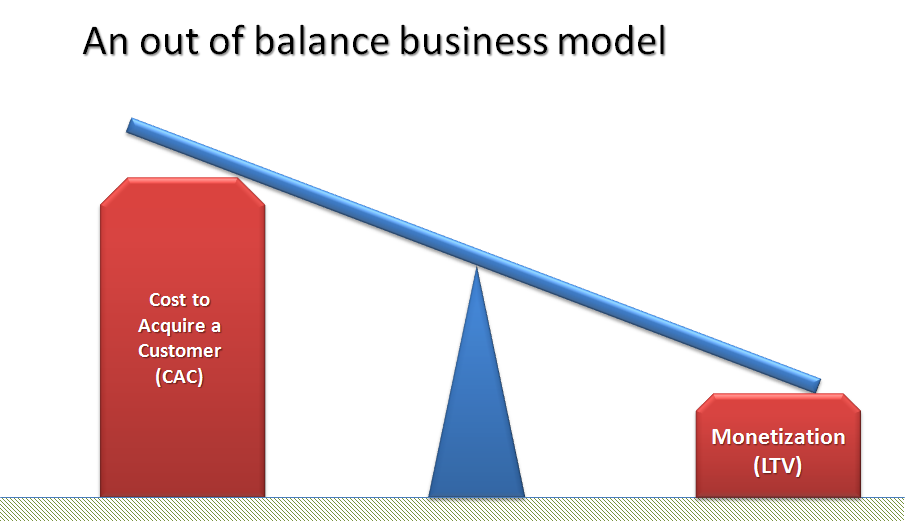
It doesn’t take a genius to understand that business model failure comes when CAC (the cost to acquire customers) exceeds LTV (the ability to monetize those customers.
A well balanced business model requires that CAC is significantly less than LTV:
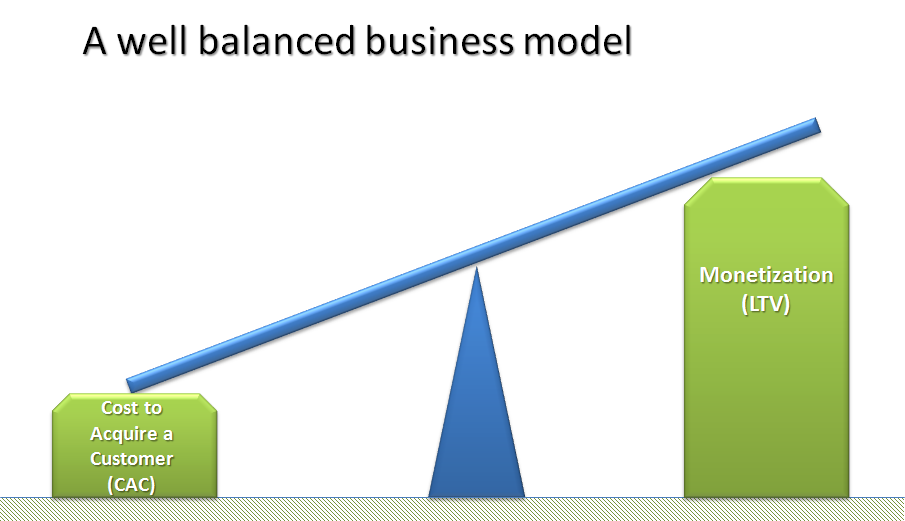
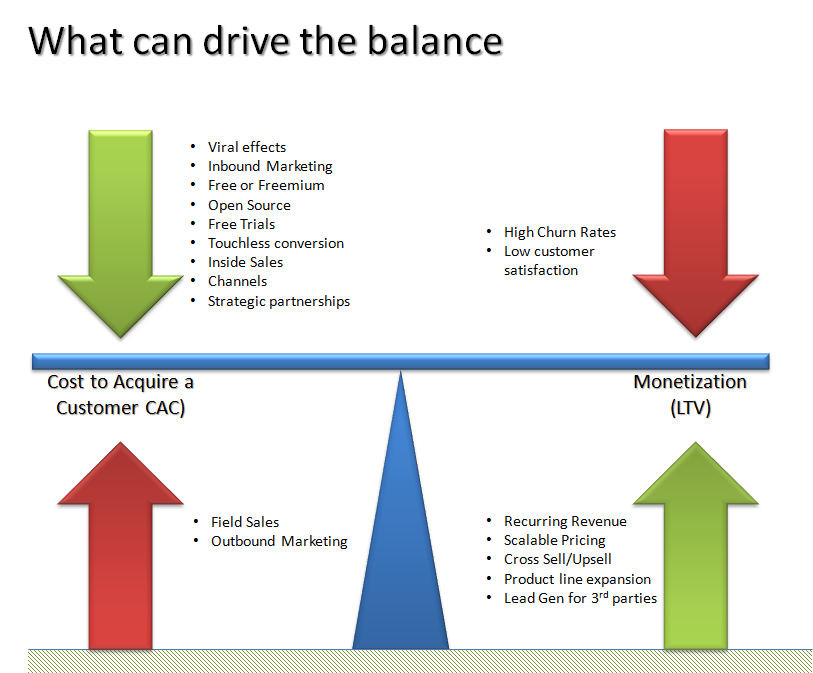
Since the above two diagrams are so obvious, you may wonder why I have included them. The goal is give the reader a sense of the balancing act required to create a profitable business. Hopefully the value will become more obvious with the third version of the diagram that shows the different factors that affect the balance.
Another reason for stressing the point using diagrams is that many entrepreneurs have realized that since the web provides some amazing new ways to acquire customers at low cost, several new businesses have become possible. The only thing that you have to consider is can you monetize your customers at a higher level than the cost to acquire them.
The Entrepreneur’s Achilles Heel: Optimism
To be an entrepreneur requires great optimism, and a very strong belief in how much customers will love your product. Unfortunately this same attribute can also lead entrepreneurs to believe that customers will beat a path to their door to purchase the product. This frequently causes them to grossly underestimate the cost it will take to acquire customers.
A common scenario is an entrepreneur that has dreamt up a cool new service that they can offer via the web. As a VC, I have sat through many presentations like this, and in most cases the service is actually interesting and compelling. However in the majority of these presentations there is little or no focus on how much it will cost to acquire customers. As I ask questions to understand the thinking, what usually comes out is something vague along the lines of web marketing, and/or viral growth with no numbers attached.
A quick look around all the B2C startups shows that, although viral growth is often hoped for, in reality it is extremely rare. When it does happen, the associated businesses are usually extremely attractive, provided they have a way to monetize their customers. (For more on the topic of Viral Growth, refer to my blog post on that topic here.)
Far more common is a need to acquire customers through a series of steps like SEO, SEM, PR, Social Marketing, direct sales, channel sales, etc. that will cost the company significant amounts of money. What shocks and surprises many first time entrepreneurs is just how high the numbers are for CAC using these kinds of techniques.
Some examples of CAC calculations
For example, if you are using Google Ad Words to drive traffic to your site, take a look at the following interactive spreadsheet. This example shows a cost per click of 50 cents, and the resulting website visitors converting to a trial at the rate of 5%. Those trials are then shown converting to paid customers at the rate of 10%. What the sheet shows is that each customer is costing you $100 in just lead generation expense. For many consumer facing web sites, it can be hard to get the consumer to pay more than $100 for the service. And this cost does not factor in the marketing staff, web site costs, etc.
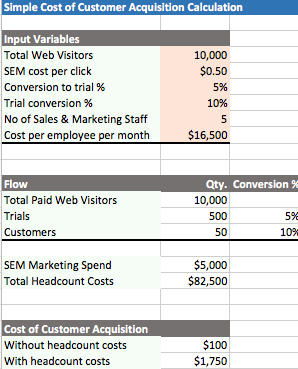
One of the more interesting things that this model shows is how rapidly cost of customer acquisition climbs If your leads require human touch to convert them, (compare cell B23 with cell B22.) This human touch can be as light as email follow ups, or as much as inside sales people doing multiple sales calls and demos. I have seen this cost vary from around $400 to $5,000 per customer acquired, depending on the level of touch needed.
Another shocking computation is to look at the cost of a direct field sales force:
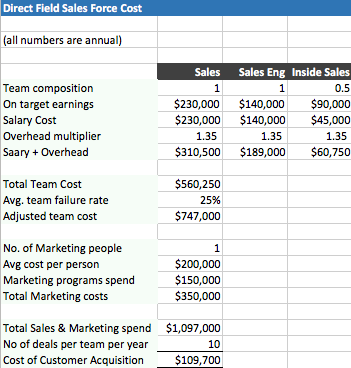
This shows is that it is not unusual for the cost of acquiring a customer to be as high as $100,000. This number is heavily dependant on the productivity of your sales teams. In the model above, this was set to 10 deals per year per team. Given the need to cover R&D and G&A costs, the average gross margin on a deal needs to be at least $150k.
Lessons Learned – Business Planning Stage
My advice to entrepreneurs working on a new business plan is to build a model similar to those above to estimate the cost of customer acquisition. This is going to show you the dependency on several critical variables:
- Cost per lead
- Conversion rates at each stage of your sales process
- Level of touch required
Then compare this to your expected monetization. As a very rough rule of thumb here are two guidelines that you might find helpful:
- LTV > CAC. (It appears that LTV should be about 3 x CAC for a viable SaaS or other form of recurring revenue model. Most of the public companies like Salesforce.com, ConstantContact, etc., have multiples that are more like 5 x CAC.)
- Aim to recover your CAC in < 12 months, otherwise your business will require too much capital to grow. (Banks and wireless phone companies ignore this rule, but they have access to tons of capital.)
In the early days of the business, you will not be able to accurately predict your conversion rates, and the viability of your entire business may depend on this. So I recommend building an execution plan that focuses on finding out what these numbers will be as soon as possible in the lifecycle of the business. Good numbers will enable you to raise funding easily, and bad numbers may indicate that this is not a viable business.
The good news is that if you can monetize your customers at a higher rate than the cost to acquire them, you probably have a great business on your hands.
Next Generation Business Models
Because a number of smart entrepreneurs realized the importance of lowering CAC, they created new business models such as Open Source, SaaS, Freemium, etc. that directly tackled the problem of acquiring customers. Some of the early B2B pioneers in this space were companies like JBoss (story here), SolarWinds, ConstantContact, HubSpot, etc. Once others started to see the success these companies were having, they started copying the techniques.
These new business models focused heavily on how buying behavior has changed because of the power of the web. Think about your own behavior: if you are like me, you hate having to deal with sales people, and greatly prefer to do your own research starting with search engines, and leveraging free trials, on-line videos, blogs, reviews, and your social network. To adapt to this, the new business models make use of a variety of techniques described below:
- Extensive use of the web to drive lead flow. In particular, the best practices include using Inbound Marketing to build traffic, instead of paying for traffic with search ads. (Read Get Found using Inbound Marketing to find out more.)
- Use of a free product or service to attract web visitors, and aim for a viral spread as they tell their friends. Examples of free products include Open Source software, services like HubSpot’s Website Grader, free versions of a SaaS service that have limited, but still valuable, feature sets, etc. For more info on this topic refer to The power of Free.
- Use of a free trial, where the customer can easily download, or use a SaaS version of the full product to see if it works for them.
- Leveraging the power of your customers’social networks to get viral growth where possible.
- Use of the touchless conversion to convert trials to paying customers.
- Using low cost inside sales when the touchless conversion is not possible.
- Extensive use of software to automate all processes such as SEO, SEM, social networking, lead scoring, lead nurturing, CRM, etc.
- Metrics on all aspects of the customer acquisition process to find out what can be improved.
These techniques are frequently referred to as the Low Cost Sales model, or as Sales 2.0.
Balancing Monetization with CAC
The way in which these techniques can work together with other techniques to drive up monetization (e.g. recurring revenue) are illustrated in the diagram below:
Lessons Learned – Ways to reduce customer acquisition costs
Conversion rates play an extremely important role in your customer acquisition cost. Anything you can do to improve conversion rates is obviously a good thing. For more on this topic, please refer to the Building a Sales and Marketing Machine part of this web site.
- Consider using A/B testing to improve conversion rates. Web traffic can be easily split so that parts are fed to different landing pages with different offers, and the resulting conversion rates measured.
Look at the level of touch required to complete a sale. Some products are easily understood, while others may require a careful walk-through by a sales person. Sometimes, the customer will want a trial with their own data. With certain complex products, this will need an on-site installation by a sales engineer, which sends costs through the roof. Consider every possible way to minimize this. For example:
- Create demo videos that answer every likely sales question.
- List the common sales objections that come up in the sales cycle, and provide answers to these on the web site.
- Try using customer references to avoid the need for a trial
- If your customers are going to compare you to the competition as part of their process, consider doing this for them, with a section of your site that has a comparison matrix with appropriate check marks.
- If you have a light touch sales model, consider setting yourself the goal of a “Touchless Conversion”, i.e. getting rid of, or minimizing the touch required to close the sale. As shown in the model, this has a huge impact on cost of customer acquisition.
Options for products requiring high touch
The toughest business models are those that employ expensive field sales organizations. The high salaries and commissions for sales people, sales engineers, travel costs, and office costs add up to an extraordinarily high figure. And this is before you factor in the failure rate (the percentage of sales people hired that don’t become productive). It is not too surprising that VCs are not aggressively pursuing these kinds of businesses. There are some ways you can look to address the problem:
- If you are currently using a field sales organization that sells direct, look at whether it is possible to sign up OEM deals with strategic partners to leverage their customer base and distribution power. What generally works best here is allowing the OEM to sell only a base layer of your product with co-branding. Then you can go back into their customers and upsell them. Owning the customer base is an important way to control your own destiny, and will also earn your company a higher valuation. In addition to distribution power, these kinds of relationships solve the “safe choice” concern of many buyers, and can transform your business.
- Consider converting to a channel sales model at some stage in the lifecycle of the business. Many times this requires that you “prime-the-pump”, as most resellers won’t sell a product until they see clear customer demand. Channel sales models usually only work when the company commits to them fully, and passes all orders through the channel, so be prepared for the loss of margin this will represent to your current order flow.
- Another option is to evaluate whether you can move from field sales to inside sales people. Insides sales people are not only less expensive in direct salary costs, but also in travel costs. Other advantages of inside sales people is that they are far more efficient due to remaining in one location, and can contact more people in a typical workday. At a minimum, look at combining inside sales with field sales to improve the efficiency of field sales people.
Conclusions
If you are entrepreneur planning your next business, you can’t afford to ignore the cost of customer acquisition. The earlier you work on this the better, as many of the best techniques require you to build your product differently.
It is also important to ask yourself the question: can my business realistically expect to acquire customers for considerably less than the amount that I can monetize them?
Once you have completed the product, you will want to familiarize yourself with all the latest techniques involved in the low cost sales model, or Sales 2.0.
From a funding standpoint, it is useful to know that your ability to raise capital will dramatically improve as soon as you have proven that you have a viable business model. Think of that as two equations:
- CAC < LTV (3x appears to be a rough minimum for SaaS businesses)
- CAC should be recovered in < 12 months (for subscription businesses)
Once you have proven out the business model, hit the accelerator pedal, and invest as much as you can afford. You’ll want to grow the business as fast as possible before a competitor realizes what you have done, and tries to steal your market!
Acknowledgments
I would like to thank my partner Nick Beim and the management teams at JBoss and HubSpot, Gail Goodman of Constant Contact, Sheila Marcelo of Care.com, for contributing greatly to the ideas in this post.
- David Skok

Mr. Skok -
Thanks, great article. In the current economic time, with capital markets tight with money, how do you best balance the right number for customer acquisition with scaring potential investors off? Giving an investor an accurate, but big, customer acquisition cost has either scared off investors our made them skeptical that we are not spending enough.
Our business is a little different than a technology company, we sell organic skin care, so our acquisition costs are high to create the demand for our product such that retail outlets will carry our product line. So far we have been very effective using blogs, social networks, etc. In addition we are using external sales forces to represent our product into existing accounts.
These observations are gold
The real issue that they should be focused on is not how big your costs of acquisition are, but are they balanced by an appropriate return. In an indirect model such as you have selling through retail, the hard problem for you is measuring the return. Investors are likely to be skittish until you have some way to show that there is a real ROI for the dollars you are spending to drive demand. There are too many cases where the spending just didn't produce the desired result.
Investors love web models because it is so much easier to measure this ROI. I wish there was a similar situation for indirect sales through a retail channel.
It's funny that you mention this. We only started measuring Customer Acquisition Cost really recently. And I know a handful of other startups run by friends of mine that are also only now looking at this. If things are going well, you tend to forget to think about it. If things aren't going well, you never really have a chance to.
new to this blog.
great in-depth article.
looking forward to reading the archives
I was trying to explain some of this the other day to my boss and chairman. I'm in charge of marketing, and of course I'm being constantly asked about the cost of customer acquisition from marketing. I've reminded them that we can't simply look for a balance of what the marketing is costing us now, but also what the 5+ years of development of several products have cost us. We've had 5M+ VC investment and been through 4 different products, only the last of which came to market fully.
They are fretting over the early costs of marketing being $1-2/user, but I had to point out that we've probably spent $1000+/user so far in total costs and that the marketing is less than 1% of the total customer costs right now. Of course as the person in charge of marketing I want to have the largest budget I can to execute, but I'm having trouble getting it because they think my end is too high (but they aren't really watching costs on the other end).
Of course, your first user will (or should) be the most expensive user. Each one after that decreases your total costs drastically per user.
Example: I want our company to attend some big upcoming events. They are wondering exactly how many people will sign up at those events. If I say that 500 will sign up there and potentially more later, then they hear 500- regardless of influence of the people. This is a mistake. What is Twitter hadn't gone to SXSW in 2007? Were the few hundred people who signed up there costing them more per user than their current users are? YES! Absolutely they did, but they were highly influential and mattered a lot. Of course you don't have a crystal ball and its easy to waste money on events and such, and not all will turn out to be a tipping point for your product. But the main point is that you shouldn't look at the pure cost per user of marketing only.
David – I completely hear your story, but it's hard to argue against spending on the product itself (particularly in the early days) vs. spending on the marketing.
To take a page out of Seth Godin's book – the product should do its own marketing. Meaning it may be best to spend more on a KILLER product, then let word of mouth do its work than spend on marketing a product that isn't quite there yet.
I have no idea what your product is so I can't say where you fit into this, other than being in a tough spot. Conferences can be a great boost for users, too. Good luck.
I love the depth here.
Thanks for sharing David.
I'd share more about my product, but I'd rather not publicly for obvious reasons.
I'm familiar with Seth and all of the other social media/marketing people's ideas, methods, etc.
Part of our problem is that we wasted 90% of our money on products that didn't work early on, had poor management/leadership early on, and now we're trying to pull something our of our ass to make it all right again. Needless to say, we don't have the development team (or the vision in management) to make the product a killer one. I completely agree- good products do most of the selling for themselves. We don't have a great product yet. They think it is, but they haven't evaluated the market well enough yet and aren't being realistic.
We're basically using 1 developer to make the product happen and its just a mess. I'm trying to do what I can do pull marketing together, but given a poor product and a super low budget (plus constant oversight from management) it just isn't working great.
There are two major conferences in the spring I'd like us to have good representation at, but they don't believe in impression marketing, influencers or that they'd be strong targets. If we pull this off, I'm shocked.
Sounds like quite a storm brewing and you've learned enough lessons to know
what's coming…
Maybe it's time to get on board a new ship or start your own biz!
Yea we've got some make or break meetings coming up in the next few weeks. If they work, I guess I have a job a bit longer and we might be able to shape something up, otherwise I'm out a job.
I've literally got a business plan on screen right now for another business (Which unfortunately will require some small level of angel funding at least to get off the ground) that I think really has wings.
You're not “out of a job” you're “free to pursue your dream.”
The hardest part is starting. Get going on your idea regardless of funding.
I would also consider another variable, CMC – cost to maintain a customer. Once one got their CAC in balance, it's easy to overlook the CMC.
Great piece. It's particularly helpful for startups to have some guidelines to look to like 3xLTV vs. CAC for SaaS offerings and the < 12 month CAC recovery period for subscription businesses. So often first time entrepreneurs are intensely heads down and product focused, that even if they can temper their optimism for a reality check;) -they often lack points of reference.
Hi David,
Excellent post. I like the depth you've gone to. You hint at, but don't explicitly talk about cash flow by mentioning: “CAC should be recovered in < 12 months (for subscription businesses)” I know I have often made a mistake of not looking close enough at actual cash level needed to survive until pay off depending on sales cycle. Do you think that a follow up post might include a more detailed look at cash flow? I am also thinking about discounting cash flow as implied by your “CAC < LTV (3x appears to be a rough minimum for SaaS businesses)”
Thank you,
Tristan
Thanks for the detail thoughts around CAC. I would like to add couple of more considerations…..
1. Cost to serve customers is also an important factor which will have impact on viability of the business. If cost to serve is high, it will have similar impact on the business model as does high CAC.
2. Cost to serve, if high, will limit your success in generating qualified leads through free trial. As it will ultimately increase your CAC.
Vish Agashe
http://www.linkedin.com/vishagashe
http://vishagashe.wordpress.com
Vish, you are correct, this is an important metric. However, given the right accounting treatment, it should be taken as your cost of goods sold, and therefore will reduce the LTV (Lifetime Value of the Customer).
Tristan, I like your suggestion, and will likely do a future post on the importance of managing cash, and how that changes at different stages in a company's lifecycle. Thanks!
Hi David, Great article, sound logic and lessons for all. Its really tough if your business product/service is disruptive, because the only way to overcome the high CAC is viral/Sales 2.0. I like HubSpot's model/approach although we still see early adopter behaviour even with a hot platform like HubSpot.
Other tools entrepreneurs can use out of the chute are aligned sales and marketing messaging built-in at product launch (even if its hypothetical, – it can be tuned quickly and will allow target buyer personas and likely needs to be validated quickly). In addition, the business model needs to recognize that disruptive innovation will diffuse according to a predictable pattern. What Geoffrey Moore describes as the Chasm is really a failure of sales and marketing to understand and adapt marketing and selling models to behaviour of early adopters. Gotts and Rowsell's “Why Killer Product's Don't Sell” nails this problem.
Great article, thanks for the ideas, relevant to all entrepreneurs, start-up CEO's and practicing marketers.
If you are starting a company and its a novel product/service, then beware of the problems in selling to the early adopter. Innovators will buy your stuff cos its cool, but they only represent the first 2.5% of the market, – selling to early adopters is a different story and failure to understand this has killed many companies….see my post “VC's don't make bad investments” Sales 2.0 models and viral selling has made it possible for companies like HubSpot to get out of the gate fast and control costs, but they are still selling to early adopters. Business models need to take into account the behavior of the early market (it takes longer than you think to close them and costs more than you budgeted) and the power of platforms like HubSpot to lower CAC.
Also consider that aligned marketing messaging needs to be designed into the product launch, even if target buyer persona and likely needs are hypothetical, messaging can be quickly tuned to score a bullseye.
Excellent observations, David.
I agree that some young SaaS companies grossly under-estimate the cost of customer acquisition. Even well-established providers like Taleo, Omniture, NetSuite and salesforce.com are spending more than 30% of annual subscription revenues on customer acquisition. Younger companies, such as SuccessFactors, are spending more than 80% on sales and marketing.
As you point out, some young companies are spending inefficiently on customer acquisition, spending a dollar to earn 75 cents. I have also seen some companies that actually have built an efficient customer acquisition model, but lacked the capital or conviction to fund it. I call this the “Ferrari in the garage” problem.
FYI, more here: http://saasmarketingstrategy.blogspot.com/2009/...
Peter, thanks for your comments. The data you have on your site is very interesting. We have compiled something similar, but with a different twist. I strongly agree that once a company has reached the point where it has a good LTV to CAC ratio, they should floor the pedal, and invest as fast at they possibly can.
I found the articles on your site to be great. Thanks for sharing.
- David
Mark, thanks for the input here. I have just gone out and purchased a copy of “Why Killer Products don't Sell”, as this is an area that I am passionate about.
Love this article!
I have to argue with some of the marketing techniques marked as “lower cost.” For example, “inbound marketing” can be cheap if you mean SEO, but if you mean maintaining a quality blog that's absolutely not cheap — it takes a ton of time. It's invaluable to do — I'm not saying don't do it — but it's not cheap.
Another example is “free trials.” Of course it's an excellent technique, but free trials comes with free tech support, and even if you have a great product people still have questions, run into problems, etc.. Tech support is not cheap.
Of course in the end these are minor compared to the overall point that you need to honestly and objectively measure the true cost of customer acquisition, and most people don't. Cheers!
Jason, Thanks for the positive feedback. Your comments are entirely valid.
When I used the term “lower cost”, I was referring to specifically these techniques versus other older techniques that I continue to see. The beauty of a blog, is that it can be written by the entrepreneur (e.g. Dharmesh Shah at HubSpot) in the early days to drive traffic, and it scales to large numbers without adding cost as the audience size grows. When this is used well, in combination with SEO, and social media engagement, I have seen it drive the costs per lead a lot lower than alternatives such as pay-per-click/SEM.
The beauty of the free trial is that it also scales, as the customer is doing their own selling (assuming the product has been designed right). But you are right free trials require good tech support, and may need some sales effort to close. However I have also seen this lower costs compared to the alternative of long demos being given by SEs, and multiple sales calls. So I guess the term “lower cost” is all relative to the starting point.
I appreciate your input!
Thanks, David
Thanks David for this article.
CAC is something that is keep me up these days. I am in very early stage of planning for my venture and have my first meeting with a VC in 2 days. Although I am meeting him for advice and not for funding (as its arranged by my Univ) I am taking it seriously. I am working on a SaaS venture and CAC is challenging the entire plan.
How do you look at outsourcing your sales team to an agency? Would look forward to your thoughts on it.
Thanks
Abhishek
Abishek,
Outsourcing your sales to an agency could make sense in the early days provided that you could get really comfortable that the agency will handle your customers with the same degree of love and product knowledge that you would expect from insiders. In the long run, if you start to see success, I believe you will likely want to bring this in house (unless the agency has some significant cost advantage). The reasons for that are: control over the quality of the process, cost, and ability hear the feedback from the customers during the sales cycle. If you had an outstanding agency, it is conceivable you could get all of those, but if you going beyond telemarketing, or light touch situations, I am skeptical you will be happy.
I hope this helps, and will contact you by email to see if you'd like other help.
- Best, David
David:
Thanks for sharing your knowledge and experience. At go-ESI we work with early stage enterprise software vendors (primarily Israel based). The early challenges that we deal with are focused on market validation and acceptance. The companies that we work with typically have only a handful of customers when we first engage, mostly in Israel. Finding the first US or European customers and turning them into great references is our initial goal. Early stage companies have traditionally done this as an isolated activity that is opportunistic and rolodex based, with the founders driving the action. What we have witnessed are two possible outcomes — either they are so excited by their success that they continue in this mode until they either run out of friendly contacts or are consumed due to a flawed or non-existent business model, or the activity comes to an end when they achieve the goal of 5-10 reference accounts. Either way, they are forced to the planning table and the business stutters and stumbles while they try to figure out how to move forward.
What we preach is that this reference customer hunting activity is possibly the most critical activity that they will undertake. We try to get them to plan around developing an understanding of what their customer acquisition strategy will be and then get them to constantly refine this as they engage with the early customers and truly learn what works and what doesn't. Our aim is to move them smoothly from market validation to customer acquisition. Thinking about all of the key issues mentioned in your blog is precisely what we want them to do.
I would be interested to learn about your experiences in working with early stage companies and how they can avoid the stop/start enigma that so many of them go through. With product life cycles shortening, they cannot afford any extended slowdown after the initial push into the market.
Darroll,
I have not yet blogged on the subject of customer validation, but as you might gather, that is another subject that I am very passionate about. I agree that most startups do not focus enough on this, mostly because it is hard, and they prefer the easier work of building the product. Helping them to find those customers makes that job a lot easier, and is a highly valuable service. I agree that this is probably the most critical activity that they will undertake in the early days, and can save them from launching the wrong product, or cut many months off the time to get to product/market fit.
The companies that are the most successful combine many interactions with customers throughout the product design and development process. Many times we will meet with technical founders that need to be paired with a business partner to help them accomplish this. We like to help them find the right business partner. CloudSwitch is a good example of this. We helped introduce the technical founder, John Considine, to Ellen Rubin, who became his business-focused partner. Ellen then did a spectacular job of finding customers and getting their feedback right from the early days.
It sounds like your firm offers a very valuable service. Do you also do this in the USA?
David:
We are actually based in the US and provide services in the US and Europe. The profiles of the go-ESI partners can be seen at http://go-esi.com/Team.aspx.
When the solutions you sell require an expensive field sales force to gain traction in the market resulting in high customer acquisition cost, it is important that you choose your customers (and prospects) carefully. Without an understanding of a customer selection model for your specific business, you will have a hard time optimizing your routes to market and monetizing your solution.
The “cost to serve” a customer has to be balanced against the profit margin that the customer can generate. You also need to take into account the lifetime value of the customer as noted in the article. If the customer is “costly to serve but willing to pay” because of the unique value your solution provides, a direct sales force is an option that will help prime the pump as you build an OEM and Channel model. Those opportunities that are more transactional or where there is no substitute in the market, that require little product customization or an installed base, can be served by a mix of lower cost inside sales, OEM sales, and channels.
On the other hand, those customers/prospects who generate a low profit margin and are costly to serve will put you out of business quickly. The characteristics of these customers and opportunities include those where there is high pre-sales support required, high technical demands, extensive product customization, small deal size, and finally, no alignment at the customer on the core value of the product or serevice you are selling can be achieved. These are the “Dogs”, learn to recognize them quickly and run the other way.
I love this post and it is oh so true. The cost of customer acquisition using outbound techniques is cost prohibitive and companies need to look for cost effective ways to attract and convert buyers.
Jeff Ogden, President
Find New Customers “Lead Generation Made Simple” (a young startup)
http://www.findnewcustomers.net
It's quire comprehensive article. Thank you, David.
One of the vital success projection criteria for any startup is the level of utilization of performance marketing model – tradition, such as CPA / CPL / CPS as well as new models such as PPD (Pay Per Deal).
How to acquire customers with the highest MROI is the key strategic and tactical question to be asked.
Alex, that is very true. When looking at these performance based traffic generation channels it is also very important to consider what conversion rates to model. These vary greatly from business to business, but there are some rough ranges that can be used for estimates until real data is harvested. Thanks, David
David–can you direct me to sources of “rough ranges” that can be used for estimating CAC until post-launch test data is received? Thank you. Cathleen
Cathleen, Unfortunately there are no public sites that have this data nicely collected in one place. You would have to try to look at presentations from various companies like Dropbox and Xobni that have provided their information publicly. However if you can tell me the stages that you expect to have in your funnel process, I can try to give you some of the data that I have personally seen and heard about. I realize this may be confidential, so feel free to email that to me directly. (dskok at matrixpartners.com).
Here are some useful links:
http://www.slideshare.net/adamsmith1/from-zero-...
http://www.slideshare.net/gueste94e4c/dropbox-s...
Best, David
David–can you direct me to sources of “rough ranges” that can be used for estimating CAC until post-launch test data is received? Thank you. Cathleen
Cathleen, Unfortunately there are no public sites that have this data nicely collected in one place. You would have to try to look at presentations from various companies like Dropbox and Xobni that have provided their information publicly. However if you can tell me the stages that you expect to have in your funnel process, I can try to give you some of the data that I have personally seen and heard about. I realize this may be confidential, so feel free to email that to me directly. (dskok at matrixpartners.com).
Here are some useful links:
http://www.slideshare.net/adamsmith1/from-zero-...
http://www.slideshare.net/gueste94e4c/dropbox-s...
Best, David
I am agree with landlord.Here provide many game for everyone . Wonderful artical excelling nature images. Let you have unexpected surprise. After you play game tired ,you can come to these websites http://www.air-jordan-7.com/ to relax your mood.
I would further say that for SaaS that are using credit card subscriptions (i.e. touchless transactions), the CAC should include your infrastructure costs (storage, bandwidth, servers, etc.) for acquiring said customers (free 1GB, 3 users, etc.).
Acquiring new customers should be a priority in most all businesses and you offer a very thorough explanation of it. In a shorter version, we suggest a few questions for business owners to answer.
Hi David! Another absolutely amazing article. Just a quick note: the embedded spreadsheets are not appearing for me – not sure if they are for others either, but worth checking.
Try using Firefox or Google Chrome. It works with both of those and they’re both really great Browsers.
Best, David